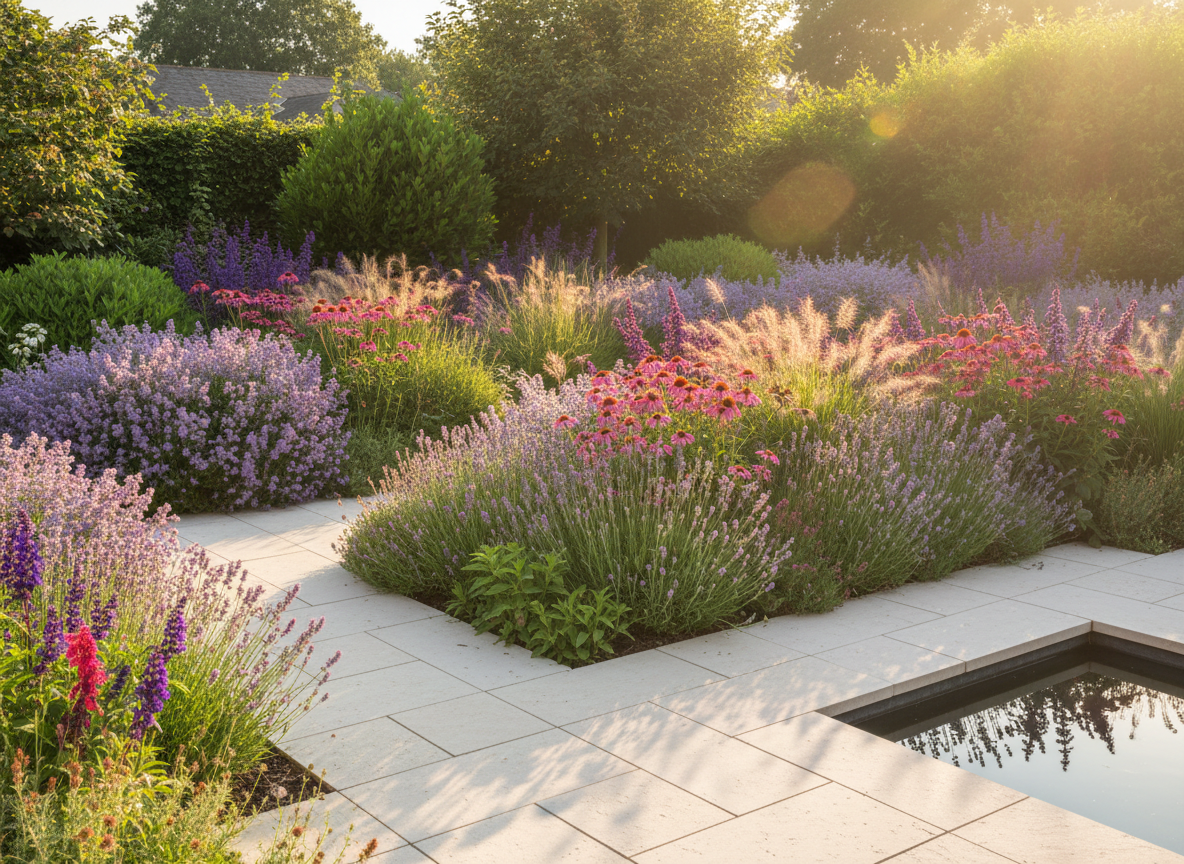
August is the most demanding month in the South East London garden calendar. Temperatures regularly exceed 28°C, rainfall becomes unreliable, and the urban heat island effect means gardens in Greenwich, Blackheath and Lewisham can run 3–4°C hotter than the surrounding countryside. The gardens that thrive in August are not the ones that get watered more — they are the ones that were designed and planted with heat resilience in mind.
This guide covers everything you need to know to keep your SE London garden performing through the hottest weeks of the year: heat-resilient plant selection, deep watering strategy, sustainable maintenance practices and the design principles that make a garden genuinely summer-proof.
Why August Is Different
By August, your garden has been under sustained heat stress for 6–8 weeks. Soil moisture reserves are depleted. Plants that looked healthy in June may be showing signs of stress — yellowing foliage, wilting despite watering, or simply stopping growth altogether. London clay soil, which holds moisture well in spring, can bake into a near-impermeable crust by mid-summer, causing water to run off rather than penetrate.
The good news is that August is also one of the most visually rewarding months if your planting scheme is right. Heat-tolerant perennials reach their peak. Ornamental grasses catch the low evening light. Late-summer flowering plants deliver colour precisely when the garden needs it most. The key is knowing which plants to rely on — and how to support them through the toughest weeks.
1. Heat-Resilient Plants for SE London Gardens
The most effective heat-resilient planting schemes share a common approach: Mediterranean and prairie-inspired plants that evolved in dry, sunny conditions. These are not compromise plants — they are genuinely beautiful, and they perform exactly when everything else is struggling.
Perennials That Peak in August Heat
- Echinacea purpurea (Coneflower): One of the most reliable August performers. Bold, daisy-like flowers in pink, white and deep magenta. Drought-tolerant once established. Excellent for pollinators. Seed heads persist into autumn, providing structure and wildlife value.
- Nepeta (Catmint): Soft lavender-blue flower spikes that bloom from June through September. Virtually indestructible in dry conditions. Cut back hard after the first flush for a second wave of colour. Pairs beautifully with roses and grasses.
- Salvia nemorosa: Upright spikes of violet-blue flowers. Drought-tolerant, long-flowering and loved by bees. Varieties like 'Caradonna' and 'Mainacht' are particularly reliable in London conditions.
- Lavender: The quintessential heat-tolerant plant. Thrives in poor, well-drained soil. Fragrant, pollinator-friendly and structurally attractive even when not in flower. Prune after flowering to maintain compact shape.
- Verbena bonariensis: Tall, airy stems with clusters of purple flowers that seem to float above the border. Self-seeds freely, creating a naturalistic effect. Exceptional drought tolerance once established.
- Agapanthus: Bold, architectural flower heads in blue and white. Thrives in heat and full sun. Excellent in containers where drainage can be controlled. Flowers from July through September.
Ornamental Grasses for August Drama
Ornamental grasses reach their peak in late summer, catching low evening light in a way that no other plant can match. They are also among the most drought-tolerant plants available for London gardens.
- Miscanthus sinensis: Tall, feathery plumes from August through winter. Dramatic in evening light. Varieties like 'Gracillimus' and 'Morning Light' are elegant and reliable.
- Stipa tenuissima: Fine, silky texture that moves in the lightest breeze. Full sun, excellent drainage. Creates a soft, naturalistic effect.
- Pennisetum alopecuroides: Bottlebrush flower heads from August to October. Compact, reliable and beautiful. 'Hameln' is the most commonly planted variety in SE London.
Evergreen Structure Plants That Handle Heat
A garden with strong evergreen structure looks good even when summer-flowering plants are stressed. These are the backbone plants that hold the design together through August and beyond.
- Pittosporum tenuifolium — compact, glossy, handles heat and drought well
- Phormium tenax (New Zealand Flax) — bold, architectural, thrives in full sun
- Fatsia japonica — excellent in partial shade, large glossy leaves stay fresh through heat
- Trachelospermum jasminoides (Star Jasmine) — evergreen climber, fragrant, heat-tolerant
2. Deep Watering Strategy for August
The most common watering mistake in August is watering too frequently and too shallowly. Light, daily watering encourages roots to stay near the surface — exactly where the soil dries out fastest. Deep, infrequent watering trains roots to grow downward, where moisture is more stable.
The Deep Watering Approach
- Water early morning (5–8am) to minimise evaporation and reduce fungal disease risk
- Water deeply and less frequently — aim for soil moisture at 15–20cm depth
- Use a soaker hose or drip irrigation to deliver water directly to the root zone
- Avoid overhead watering in heat — wet foliage in sun causes scorch and disease
- Check soil moisture with a finger or moisture meter before watering — don't water if still moist at 5cm depth
Watering Priorities by Plant Type
New planting (under 12 months)
Water 3–4 times per week in August. New plants have not yet established deep root systems and are most vulnerable to heat stress. This is non-negotiable.
Established borders
Water deeply once or twice per week. Check soil moisture before watering. Mulched borders need less frequent watering.
Containers and pots
Check daily — containers can dry out completely in 24 hours during August heat. Water until it drains from the base. Consider moving to partial shade during extreme heat.
Lawns
Most established lawns can tolerate August drought and will recover in autumn. Raise mowing height to 4–5cm to shade the soil and reduce stress.
3. Mulching — Your Most Effective August Tool
A 5–7cm layer of organic mulch is the single most effective thing you can do for your garden in August. It suppresses weeds, retains soil moisture, keeps root temperatures stable and improves soil structure as it breaks down. If your borders are not mulched, this is the most urgent task.
- Apply bark mulch or garden compost to a depth of 5–7cm across all planted borders
- Keep mulch 5–10cm away from plant stems and tree trunks to prevent rot
- Water borders thoroughly before applying mulch — mulch locks in existing moisture
- Refresh any mulch that has decomposed or been disturbed since spring
4. Sustainable August Maintenance Practices
At Wicked Gardens LTD, 100% of our projects include sustainable elements. August is the month when sustainable practices deliver the most visible results — reducing water use, supporting biodiversity and keeping your garden healthy without chemical intervention.
Deadheading for Continuous Colour
Regular deadheading — removing spent flower heads — redirects the plant's energy from seed production back into flowering. In August, this can extend the flowering season of many perennials by 4–6 weeks. Focus on Echinacea, Salvia, Nepeta, Agapanthus and repeat-flowering roses.
What Not to Prune in August
August is not the time for heavy pruning. Most woody plants are still in active growth and cutting back hard can stimulate soft new growth that is vulnerable to autumn frosts. Avoid pruning:
- Roses — wait until after flowering or autumn
- Hydrangeas — leave until late winter/early spring
- Lavender — prune lightly after flowering, not into old wood
- Ornamental grasses — leave standing until late winter
- Evergreen hedges — avoid cutting in extreme heat (wait for cooler weather)
Pest and Disease Management
Heat-stressed plants are more susceptible to pests and disease. August brings spider mites, aphids and powdery mildew. Our approach is always to manage organically first:
- Inspect foliage weekly — catch infestations early before they spread
- Remove affected leaves and dispose of (not compost) diseased material
- Improve air circulation by thinning overcrowded growth
- Use neem oil or insecticidal soap for persistent pest problems — apply in early morning
- Encourage natural predators: ladybirds, lacewings and hoverflies
Rainwater Harvesting
Even in August, London receives occasional rainfall. A water butt connected to a downpipe can collect 200+ litres from a single heavy shower. Collected rainwater is better for plants than tap water (lower pH, no chlorine) and reduces your water bill. If you do not have a water butt, August is a good time to install one in preparation for autumn rains.
5. August Garden Care for Commercial Properties
For landlords and property managers in Lewisham, Greenwich and across SE London, August garden maintenance directly affects rental value and tenant satisfaction. A well-maintained garden in August — with deadheaded flowers, sharp bed edges and a healthy lawn — signals quality and care that justifies premium rents.
Key commercial priorities for August:
- Maintain crisp lawn edges along paths and borders — this has the highest visual impact
- Deadhead all flowering plants in communal areas for continuous colour
- Check and clear drainage channels before late-summer storms
- Inspect fencing and gates — summer is the best time for repairs and painting
- Ensure irrigation systems are functioning correctly before the hottest weeks
Your August Garden Care Checklist
Planning Ahead: August to Autumn
August is also the ideal time to plan for autumn. Spring-flowering bulbs need to be ordered now for September–November planting. If any plants have struggled through the summer, this is the moment to identify replacements — container-grown plants establish well when planted in September–October, giving them time to root before winter.
For gardens that consistently struggle in summer, consider a garden design consultation to build long-term heat resilience into your planting scheme. The right plant in the right place, with proper irrigation and mulching, transforms August from a month of stress into a month of peak performance.
Need professional support for your August garden?
We provide professional summer garden maintenance across Greenwich, Blackheath, Lewisham, Brockley, Nunhead and wider South East London. Scheduled visits, consistent teams and proactive plant care.
Request a Free Quote