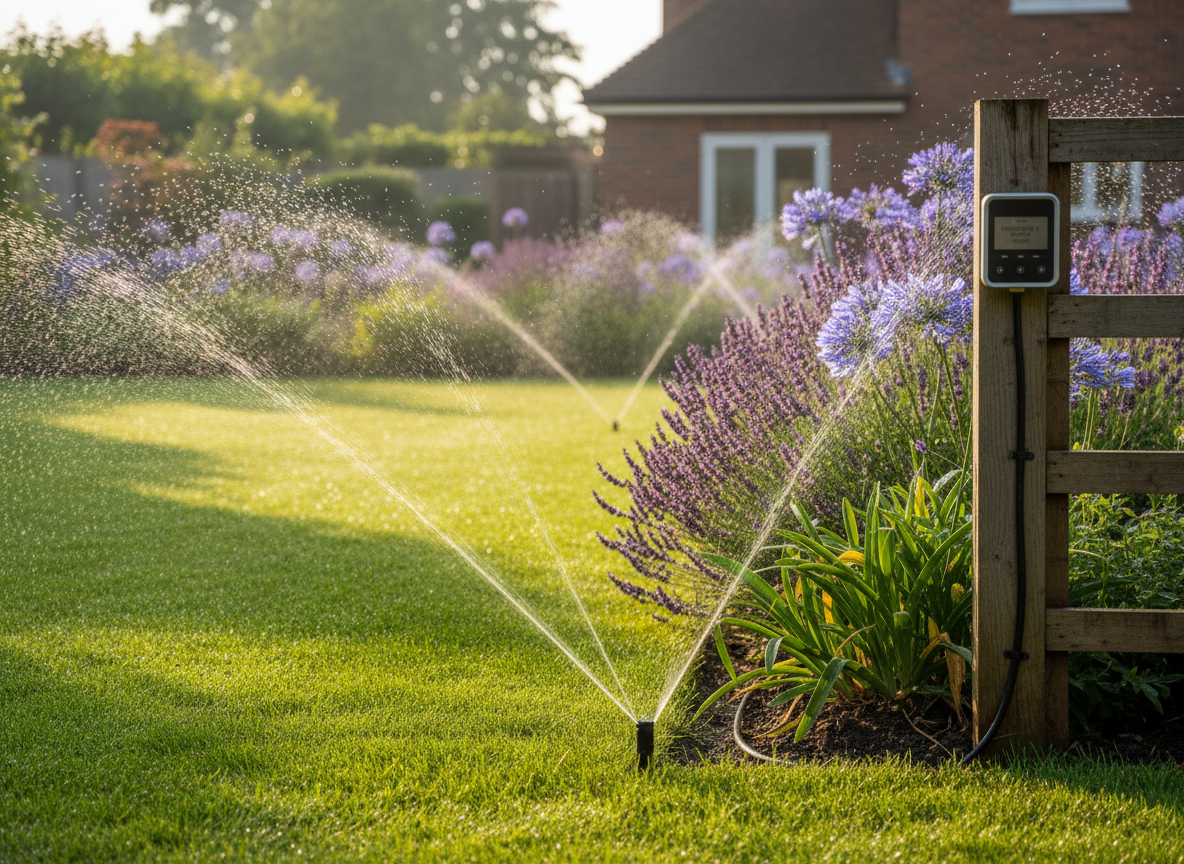
A properly designed irrigation system is one of the smartest investments you can make in your garden. It delivers the right amount of water, to the right plants, at the right time, consistently and efficiently. In South East London, where summer dry spells are becoming longer and more intense, the difference between a thriving garden and a stressed one often comes down to how water is managed.
At Wicked Gardens, we have designed and installed irrigation systems across Greenwich, Blackheath, Lewisham, Brockley, Nunhead and wider SE London for over five years. This guide covers everything you need to know, from choosing the right system type to installation costs, smart controllers, winterisation and long-term maintenance.
Why SE London Gardens Need Irrigation
London's climate is changing. Summers are hotter, rainfall is less predictable, and the urban heat island effect means SE London gardens experience temperatures 2–4°C higher than surrounding countryside. Combined with London's heavy clay soil, which bakes hard in summer and repels water, hand-watering alone is no longer enough to protect a premium garden investment.
The reality is stark: a newly landscaped garden with £5,000–£15,000 of planting can lose 30–50% of its plants in a single hot summer without consistent watering. An irrigation system costing £1,200–£3,500 protects that entire investment and pays for itself within the first dry spell.
- Consistent deep watering encourages strong root systems that survive drought
- Targeted delivery reduces water waste by 40% compared to hand-watering
- Automated scheduling means your garden is watered even when you are away
- Smart controllers adjust to weather conditions automatically
- Protects your landscaping investment during the critical establishment period
- Reduces your weekly garden maintenance time by 2–4 hours
Types of Garden Irrigation Systems
There is no single “best” irrigation system. The right choice depends on your garden's layout, planting, soil conditions and how you use the space. Most SE London gardens benefit from a combination of two or more system types, each serving a different zone.
1. Drip Irrigation (Best for Planted Borders)
Drip irrigation delivers water slowly and directly to the root zone of each plant through a network of narrow tubes with emitters spaced at regular intervals. It is the most water-efficient method available, with virtually zero waste from evaporation or runoff.
- Water efficiency: Uses 30–50% less water than sprinklers or hand-watering
- Precision: Delivers water exactly where roots need it, not on paths or paving
- Weed suppression: Dry surface between plants discourages weed germination
- Disease prevention: Keeps foliage dry, reducing fungal disease risk
- Discreet: Runs under mulch, completely invisible once installed
- Ideal for: Borders, raised beds, container planting, hedging, new planting
How it works: A main supply line runs along the border, with lateral drip lines branching off to each planting area. Pressure-compensating emitters ensure even water distribution regardless of elevation changes. The entire system sits under a 5–7cm mulch layer, keeping it invisible and protected.
SE London consideration: On London clay soil, drip irrigation is particularly effective because it delivers water slowly enough for the clay to absorb it. Fast-flowing sprinklers on clay often cause runoff. The water sheets across the hard surface rather than soaking in.
2. Pop-Up Sprinkler Systems (Best for Lawns)
Pop-up sprinklers are the gold standard for lawn irrigation. They sit flush with the ground when not in use and rise to spray water in a controlled arc when activated. Modern systems use rotary or gear-driven heads that deliver water slowly and evenly, matching the soil's absorption rate.
- Coverage: Each head covers 2–12 metres depending on type and pressure
- Invisible when off: Heads retract flush with the lawn surface
- Even distribution: Overlapping spray patterns ensure no dry spots
- Adjustable: Arc, radius and flow rate can be fine-tuned per head
- Ideal for: Lawns, open grassed areas, large planting beds
Types of sprinkler heads:
- Fixed spray heads: Best for small lawns under 4m wide. Quick coverage but higher precipitation rate.
- Rotary heads: Best for medium to large lawns. Slower, more even application. Better for clay soil.
- MP Rotator heads: Premium option. Multi-stream rotating nozzles deliver water at a very low rate, ideal for London clay. Virtually no runoff.
SE London consideration: We recommend MP Rotator or gear-driven rotary heads for most SE London lawns. Their low precipitation rate (typically 10–15mm/hour) matches London clay's slow absorption, preventing puddles and runoff that waste water and damage turf.
3. Soaker Hoses (Budget Option for Borders)
Soaker hoses are porous tubes that weep water along their entire length. They are the simplest and cheapest form of irrigation, but also the least precise. Water distribution is uneven, especially on longer runs or sloped ground.
Our recommendation: Soaker hoses are acceptable as a temporary solution during the establishment period of new planting, but we do not recommend them as a permanent system. For a premium garden, drip irrigation delivers significantly better results for a modest additional cost.
4. Micro-Sprinklers (Best for Container Planting & Roof Terraces)
Micro-sprinklers are small, low-flow spray heads designed for containers, hanging baskets and roof terrace planters. They deliver a fine mist or gentle spray directly into each container, ensuring even coverage without waterlogging.
Roof terrace note: Containers on roof terraces dry out 2–3x faster than ground-level planting due to wind exposure and radiant heat. Micro-sprinkler irrigation on a timer is essential for maintaining healthy container planting at height. See our roof terrace design service for professional solutions.
Smart Controllers & Weather-Responsive Technology
A smart irrigation controller is the brain of your system. It replaces the basic timer with an intelligent device that adjusts watering schedules based on real-time weather data, soil moisture readings and seasonal changes. The result: your garden gets exactly the water it needs — no more, no less.
How smart controllers work
- Weather integration: Connects to local weather stations via WiFi. If rain is forecast, watering is automatically skipped or reduced.
- Soil moisture sensors: Optional sensors buried in the root zone measure actual soil moisture. The system only waters when the soil genuinely needs it.
- Seasonal adjustment: Automatically increases watering in summer and reduces it in autumn/winter — no manual reprogramming needed.
- Zone control: Different areas of your garden can be watered independently. Borders, lawn, containers and hedging each get the right amount.
- App control: Adjust schedules, run manual cycles and monitor water usage from your phone — even when you’re away.
- Water savings: Smart controllers typically reduce water usage by 30–40% compared to basic timers.
Controllers we recommend
We install controllers from Hunter, Rain Bird and Orbit — all proven, reliable brands with excellent app interfaces and UK weather station compatibility. For most SE London residential gardens, a 4–8 zone controller is sufficient. Larger gardens or properties with separate lawn, border, container and hedging zones may need 12+ zones.
Integration with smart home systems: Most modern controllers work with Apple HomeKit, Google Home and Amazon Alexa. You can incorporate garden watering into your existing smart home routines — for example, automatically pausing irrigation when you open the patio doors.
Designing Your Irrigation System: Zone Planning
The most important step in irrigation design is zone planning. Different areas of your garden have different water requirements — and mixing them on the same zone leads to overwatering some plants and underwatering others.
Typical zones for an SE London garden
Zone 1: Lawn
System type: Pop-up sprinklers (rotary or MP Rotator)
Schedule: 2–3 times per week in summer, deep soak
Notes: Largest water consumer. Schedule early morning (5–7am) to minimise evaporation.
Zone 2: Planted borders
System type: Drip irrigation under mulch
Schedule: 2–3 times per week, 30–45 min per session
Notes: Pressure-compensating emitters ensure even distribution on sloped ground.
Zone 3: Hedging
System type: Drip line along hedge base
Schedule: 1–2 times per week once established
Notes: New hedging needs more frequent watering in the first 12 months.
Zone 4: Containers & pots
System type: Micro-sprinklers or drip stakes
Schedule: Daily in peak summer, twice daily in heatwaves
Notes: Containers dry out fastest. This zone needs the most frequent scheduling.
Zone 5: Raised beds
System type: Drip irrigation
Schedule: 2–3 times per week
Notes: Raised beds drain faster than ground-level borders. Adjust accordingly.
Installation Process: What to Expect
A professional irrigation installation typically takes 2–5 days depending on the size of the garden and number of zones. Here is what the process looks like from start to finish.
Step 1: Site survey & design
We visit your garden, measure the space, assess water pressure, identify planting zones and design a system layout. You receive a scaled plan showing pipe routes, head positions, zone boundaries and controller location. This is included in the quote — no separate design fee.
Step 2: Trenching & pipe laying
Main supply pipes are buried at 200–300mm depth in narrow trenches. In lawns, we use a pipe-pulling machine that minimises surface disruption — the lawn recovers within 2–3 weeks. In borders, pipes run under the mulch layer. All pipework is MDPE (medium-density polyethylene) — the same material used for mains water supply.
Step 3: Head & emitter installation
Sprinkler heads are installed at precise positions to ensure overlapping coverage with no dry spots. Drip emitters are positioned at each plant's root zone. All connections use compression fittings — no glue or solvent welding — making future maintenance and modifications simple.
Step 4: Controller & valve installation
The controller is mounted in a weatherproof enclosure near an outdoor power supply. Zone valves are installed in a valve box (typically near the water supply point) with each zone independently controlled. We connect the controller to your WiFi network and set up the app on your phone.
Step 5: Testing, programming & handover
Every zone is tested for coverage, pressure and flow rate. We adjust head angles, check for leaks and fine-tune the watering schedule for the current season. You receive a full walkthrough of the controller, the app and the manual override process. We also provide a written maintenance guide.
When to Install: Best Timing for SE London
Irrigation can be installed at any time of year, but the ideal windows are:
- During a landscaping project (best option): Pipes can be laid before surfaces are installed. Cable routes are concealed during construction. This is the most cost-effective approach — no need to dig up existing lawns or borders.
- Spring (March–May): System is ready before the first dry spell. Lawns recover quickly from trenching. Plants benefit from consistent watering during the critical growth period.
- Autumn (September–November): Good for installation before winter. System is tested and ready for the following spring. Lawn recovery from trenching is slower but still viable.
- Summer (June–August): Possible but not ideal. Ground is hard, trenching is more difficult, and lawn recovery is slower. However, if your garden is struggling in a heatwave, a retrofit installation can still save your planting.
Irrigation System Costs in SE London
Irrigation is one of the most cost-effective investments you can make in your garden. The system protects thousands of pounds of planting from a single dry spell — and pays for itself within the first summer.
Typical cost ranges (2026)
Drip irrigation only (borders)
Depends on border length, number of zones and emitter spacing.
Pop-up sprinkler system (lawn)
Depends on lawn size, head type and number of zones.
Combined drip + sprinkler system
Most common for SE London gardens. Covers lawn, borders and containers.
Smart controller upgrade
WiFi-enabled controller with app, weather integration and soil sensors.
Micro-sprinkler system (containers)
For roof terraces and container planting. Includes timer and drip stakes.
Annual servicing & winterisation
Seasonal check, flush, pressure test and frost protection.
What affects the cost? Garden size, number of zones, head types, pipe runs, smart controller features and whether the system is installed during a landscaping project (cheaper) or retrofitted to an existing garden.
Our recommendation: For most SE London residential gardens, a combined drip and sprinkler system with a smart controller costs £1,500–£3,000 and delivers the best balance of coverage, efficiency and convenience. See our full 2026 landscaping cost guide for more pricing context.
Maintenance & Winterisation
An irrigation system is a long-term investment. With proper maintenance, a quality system lasts 15–20+ years. Neglect it, and frost damage or blocked emitters can cause expensive repairs within a single season.
Seasonal maintenance schedule
Spring (March–April)
Turn on the system. Check all heads and emitters for blockages. Run each zone manually and inspect for leaks. Adjust spray patterns for new growth. Update the controller schedule for spring watering needs.
Summer (June–August)
Monitor coverage — look for dry spots or overwatering. Clean filters monthly. Check soil moisture sensors are reading correctly. Adjust schedules during heatwaves (increase frequency, not duration).
Autumn (September–October)
Reduce watering frequency as temperatures drop. Clear fallen leaves from sprinkler heads. Run a final system check before winterisation.
Winter (November–February)
CRITICAL: Drain the entire system before the first frost. Blow out remaining water with compressed air. Disconnect and store the controller indoors if possible. Insulate any exposed above-ground pipework.
Why winterisation matters: Water left in pipes expands when it freezes. This cracks fittings, splits pipes and damages valves. A single frost event can cause £500+ in repairs. Professional winterisation costs £150–£250 and takes less than an hour — it is the most important maintenance task of the year.
DIY vs Professional Irrigation Installation
Simple soaker hoses and basic drip kits can be installed as a DIY project. But for a permanent, efficient system that protects your garden investment, professional installation delivers significantly better results.
DIY is fine for:
- Temporary soaker hoses during establishment
- Simple drip kits for a few containers
- Basic timers on an outdoor tap
Professional installation for:
- Permanent multi-zone systems
- Pop-up sprinklers (require trenching)
- Smart controllers with weather integration
- Systems integrated with landscaping projects
- Roof terraces and complex layouts
Frequently Asked Questions
How much does an irrigation system cost in SE London?
A typical residential irrigation system costs £1,200–£3,500 depending on the number of zones, head types and smart controls. Combined drip and sprinkler systems for medium gardens typically fall in the £1,500–£2,500 range. We provide a detailed quote after assessing your garden.
Will an irrigation system save me money?
Yes. Smart controllers reduce water usage by 30–40% compared to hand-watering. More importantly, the system protects your planting investment — a single hot summer can destroy £5,000+ of planting that consistent irrigation would have saved.
Can irrigation be added to an existing garden?
Yes. We regularly retrofit irrigation to established gardens. Pipes can be run along fence lines, under mulch in borders and through existing planting beds with minimal disruption. Lawn sprinklers require narrow trenches that recover within 2–3 weeks.
Do I need to winterise my irrigation system?
Absolutely. Water left in pipes will freeze and crack fittings, split pipes and damage valves. We recommend professional winterisation every autumn — it costs £150–£250 and prevents hundreds of pounds in frost damage repairs.
How long does an irrigation system last?
A quality irrigation system lasts 15–20+ years with proper maintenance. Controllers may need updating every 8–10 years as technology improves. Sprinkler heads and emitters are replaceable individually if damaged.
When to Call a Professional
If your garden is struggling in summer despite hand-watering, if you are planning a new landscaping project, or if you want to protect an existing planting investment with consistent, automated watering — professional irrigation design and installation is the answer. We provide irrigation and smart garden services across Greenwich, Blackheath, Lewisham, Brockley, Nunhead and wider South East London.
Ready to install an irrigation system?
We design and install irrigation systems across South East London — from simple drip setups to full multi-zone smart systems. Free site survey, clear quote, professional installation with a 12-month workmanship warranty.
Request a Quote